Physical Address
304 North Cardinal St.
Dorchester Center, MA 02124


Every generation of data tooling has its keystone. In the 1980s, relational databases defined the foundation. In the 2000s, Hadoop represented a seismic shift in scale. Today, in the cloud-first era of the modern data stack, one tool stands out as a movement rather than just a piece of software: dbt (data build tool).
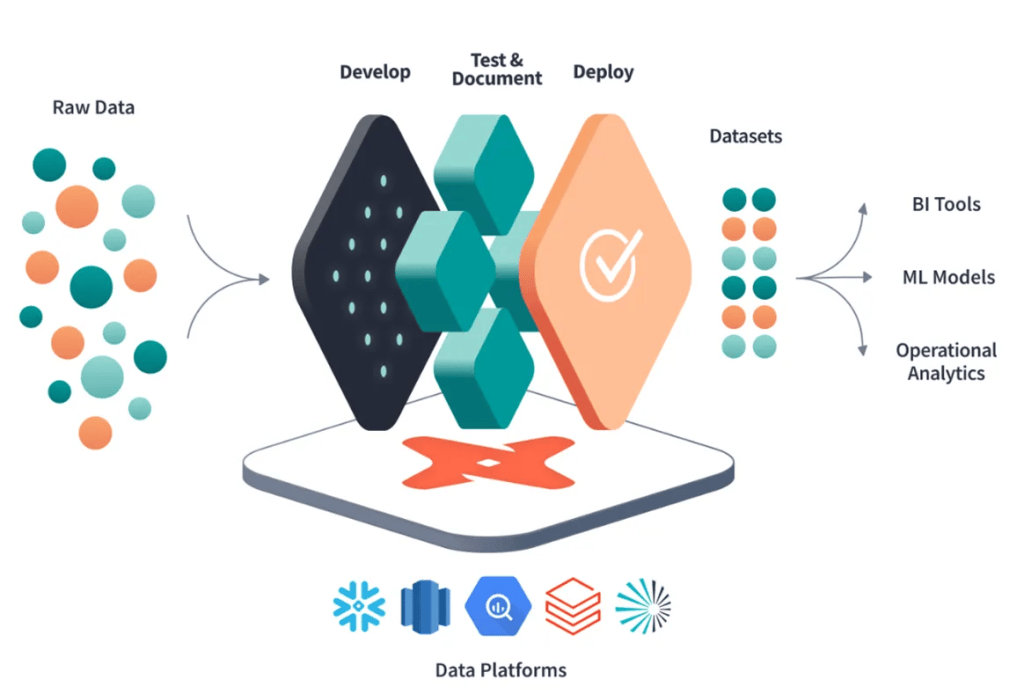
They key takeaway I want you all to understand is that dbt is deceptively simple. At its core, it lets analysts and engineers write SQL models, test them, and document them. Yet its impact on how organisations think about data transformations, governance, and team collaboration is profound. dbt has reframed transformation as a software engineering discipline rather than a collection of ad-hoc scripts.
This post explores dbt’s origins, its design philosophy, how it fits into modern architectures, and the challenges and opportunities it presents for the future.
The story of dbt begins with Fishtown Analytics, a boutique consultancy in Philadelphia. They were advising clients on building analytical data platforms and noticed a recurring pain point:
Analysts wrote fragile SQL scripts scattered across Git repos or BI tools. Engineers managed ETL pipelines with heavy frameworks like Informatica, Talend, or Airflow, which were overkill for analysts. There was no shared framework, no testing, no version control culture.
So in 2016, Fishtown released dbt as open source. Its tagline captured the intent:
“Analytics engineering is software engineering, applied to data.”
dbt rests on a simple but radical philosophy:
Instead of writing monolithic ETL jobs, dbt encourages teams to write modular models. SQL select statements saved as .sql files. dbt then compiles them into a DAG (directed acyclic graph) of transformations and runs them in the warehouse.
This reframing created the role of the analytics engineer – a professional who sits between BI analysts and data engineers, bridging business logic and technical rigor.
Every dbt model is just a SQL query. dbt materialises these as tables or views in the warehouse. By chaining models together, teams build transparent, layered transformations—raw → staging → mart.
dbt extends SQL with Jinja templating, allowing for parameterization and reusability. Common logic like is_valid_email() can be written once as a macro and reused across hundreds of models.
Data quality isn’t an afterthought. dbt integrates schema and data tests directly:
This aligns naturally with the idea of data contracts.
dbt auto-generates rich documentation websites from your models, lineage, and tests. Suddenly, your transformations aren’t a black box—they’re browsable, searchable, and linked to business logic.
The DAG view has become iconic in dbt. You can see how raw tables flow into staging models, then into business marts, and ultimately feed dashboards. This lineage makes debugging, auditing, and onboarding far easier.
dbt isn’t a silo—it’s the glue in the ELT (Extract, Load, Transform) paradigm.
In this sense, dbt turned the warehouse into the true transformation engine. No need for heavyweight Spark jobs for every task. SQL + dbt + a scalable warehouse can serve most analytical needs.
While dbt Core is open source, adoption exploded with dbt Cloud, the commercial SaaS offering. It added:
For many organisations, dbt Cloud became the “analytics OS”—a collaborative workspace unifying data engineers, analytics engineers, and BI developers.
dbt has become a data contract enforcer. Through:
This governance-first approach is why dbt is so often paired with Collibra, Alation, and data catalogs. It operationalises the semantics those tools manage.
No tool is perfect. dbt faces challenges:
Before dbt, transformations looked like:
dbt replaced this with:
This is why dbt is often described as the “Rails of Analytics”—it codified conventions and best practices.
Here are some example use cases I came across when researching the adoption of dbt.
JetBlue used dbt to centralise definitions of KPIs (on-time departures, load factor). Instead of each analyst writing their own query, dbt enforced one canonical version, improving trust.
GitLab’s all-remote data team used dbt Cloud to enforce consistent pipelines across time zones. dbt’s lineage graph helped reduce duplicated logic.
Banks adopted dbt carefully due to regulatory constraints but now use it with Collibra (insert tool of choice here…) to enforce BCBS 239 lineage requirements. dbt provides technical lineage; Collibra maps it to business terms.
dbt Labs (the company) raised significant funding and is evolving rapidly. Key trends:
dbt didn’t invent SQL, DAGs, or testing. Its genius was cultural:
In many ways, dbt is less a tool than a movement, a manifesto that says: treat data like code, and treat analysts like engineers.
The history of data is full of middleware tools that came and went. Few left a mark beyond their technical features. dbt, I believe, is different. It crystallised a philosophy that redefined an industry.
As organisations wrestle with data contracts, semantics, and AI-powered analytics, dbt sits firmly at the centre. Whether you run it as open source or in dbt Cloud, the question is no longer “Should we use dbt?” but “How far can we take it?”
Because in the end, dbt is not just about transformations. It’s about expectations. The expectation that data work should be transparent, testable, collaborative, and, most importantly, trusted. It’s a step in the right direction.


You must be logged in to post a comment.