Physical Address
304 North Cardinal St.
Dorchester Center, MA 02124


We don’t really think about where the data is physically stored. In the digital world, storage is the unsung hero. Data scientists, AI models and analytics tools often take centre stage, but none of them work without a place to store the data. From the faint hiss of a magnetic tape reel in a 1960s data centre to the silent flash of an SSD in today’s cloud infrastructure, storage has been the backbone of every technological leap.
The story of storage is also the story of how we’ve learned to speak to data:
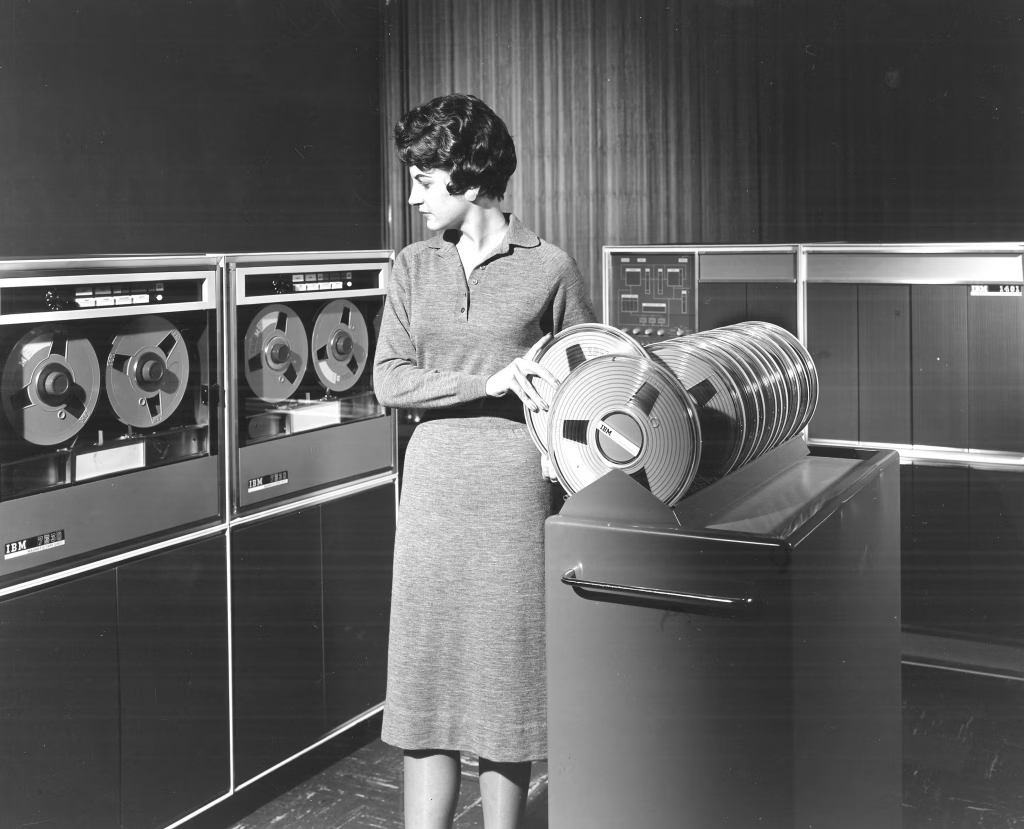
In the 1960s, “storage” meant physical space. Data was stored on magnetic tape reels, each holding a few megabytes at most.
Tape was cheap compared to disk, but slow. If your data was at the end of the reel, you waited. Engineers worked like librarians in a giant mechanical library, retrieving the right reel and mounting it onto a drive.

When IBM introduced hard disk drives (HDDs) in the late ‘50s, they were the size of washing machines. By the 1970s, they were still massive but had become the default for live data access.
This was the era of:
The real win? You no longer had to read every record to find one — you could *seek* directly to it.

As businesses moved into client–server computing and data warehouses, storage demand exploded.
Suddenly, data wasn’t just operational — it was strategic. Storage powered analytics, forecasting, and the first real-time dashboards.

The early 2000s brought an avalanche of unstructured data: emails, web logs, videos, images. Storing it meant new approaches.
This was also the birth of the “store everything” mentality — disk was getting cheaper, and distributed file systems like HDFS made it possible to keep petabytes online.
Solid State Drives (SSDs) left spinning disks in the dust for performance-critical workloads.
* Latency dropped from milliseconds to microseconds.
* Capacity still lagged behind HDD, but hybrid storage tiers combined speed and scale.
* Object storage in the cloud (AWS S3, Azure Blob, Google Cloud Storage) became the default for many organisations.
Data lakes emerged — cheap, scalable repositories that could hold structured and unstructured data side-by-side.
Today, the storage conversation isn’t about gigabytes or terabytes. It’s about location, resilience, and intelligence.
– Multi-cloud and hybrid storage strategies
– AI-driven storage tiering that moves data automatically to optimise cost and performance
– Edge storage for IoT and real-time processing.
And the numbers? Enterprise datasets are measured in petabytes and exabytes – volumes that were unimaginable when the first magnetic tapes were created. Understanding storage history isn’t just nostalgia, it’s an importandesign point when considering all storage opions. The constraints of the past shaped database design, data modelling, and processing patterns. Many legacy architectures are really artefacts of old storage limitations. If you know how storage has evolved, you can better predict where it’s heading and design systems ready for what comes next. The journey from tape to terabytes is also the journey from data as a byproduct to data as an product. And as we head into the AI age, the real question might not be where*we store our data, but how smart our storage can become


You must be logged in to post a comment.